House Edge in Casino Games: How the Mathematical Advantage Is Built Into Every Game and How It Varies Across Game Types
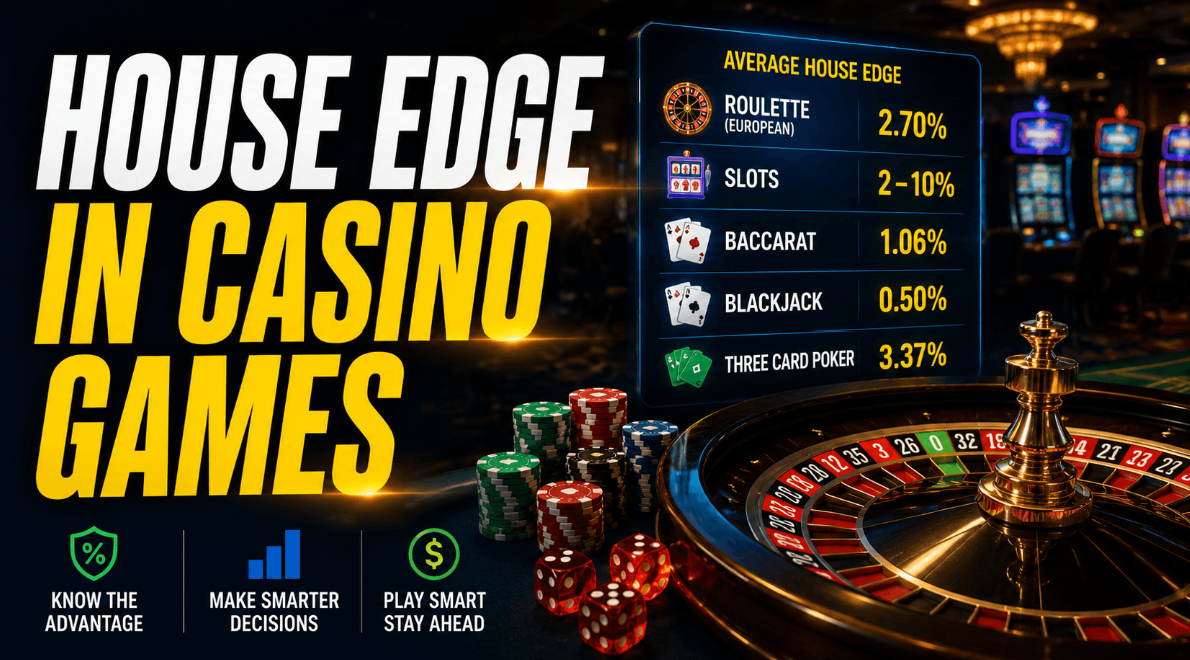
Every casino game you play is engineered to return slightly less than what you put in — over time and across enough bets. That gap is the house edge. Understanding it won't change the math, but it will change how you choose where to put your money. And for players who do their research before sitting down at a table or opening a slot, that knowledge matters.
What Is the House Edge?
The house edge is the casino's built-in mathematical advantage over a player, expressed as a percentage of each bet wagered. It represents the average amount the casino expects to keep from every unit staked, calculated over an infinite number of rounds.
So if a game carries a house edge of 2.70%, the casino expects to retain $2.70 for every $100 wagered — not per session, but as a long-run average. Individual sessions will swing wildly. The edge only becomes reliable across millions of bets.
Whether you're accessing games through a desktop browser or via 1xbet mobile on your phone, the house edge embedded in every game remains constant. It's not a policy decision. It's a mathematical property of the game's structure.
How the House Edge Is Calculated: The Core Formula
Expected Value and How It Defines the House Edge
Expected value (EV) is the mathematical foundation. It calculates what a player can expect to gain or lose per bet, on average, across all possible outcomes weighted by their probability.
Formula: EV = Σ (Probability of outcome × Payout for that outcome)
A negative EV means the player expects to lose money. The house edge is simply the absolute value of a player's negative EV expressed as a percentage of the original bet.
House Edge = –EV / Bet Size × 100%
How Payout Ratios Below True Odds Create the Edge
True odds are the actual probability of an event occurring, expressed as a payout ratio. When a casino pays less than the true odds, it keeps the difference. That's the edge.
Example: Flipping a fair coin. True odds are 1:1 — you stake $1, you win $1. If a casino paid only $0.95 on every win, the EV would be negative and the house edge would be 2.5%.
Every casino game works on this principle. The payouts are set slightly below what the true probability would justify.
Step-by-Step Numeric Example: Roulette House Edge Calculation
European roulette has 37 pockets: numbers 1–36 and a single zero.
- Step 1: Identify the bet. You bet $1 on a single number (straight-up bet).
- Step 2: Find the true probability. 1 in 37 = 0.02703 (2.703%).
- Step 3: Note the casino payout. The casino pays 35:1 — you get your $1 back plus $35 profit.
- Step 4: Calculate expected value. EV = (1/37 × $35) + (36/37 × –$1) = $0.9459 – $0.9730 = –$0.0270
- Step 5: Express as a percentage. House edge = $0.0270 / $1.00 = 2.70%
That 2.70% applies to every bet type in European roulette (except La Partage rules on even-money bets).
How House Edge Differs from RTP
The Mathematical Relationship: House Edge = 100% − RTP
RTP, or Return to Player, is the percentage of all wagered money that a game pays back to players over time. The relationship to house edge is direct and simple:
House Edge = 100% − RTP RTP = 100% − House Edge
A slot with 96% RTP carries a 4% house edge. European roulette at 2.70% house edge has an RTP of 97.30%.
Why Both Metrics Describe the Same Mathematical Reality
They're the same number, viewed from different sides. House edge is framed as what the casino keeps. RTP is framed as what the player gets back. Neither is a per-session guarantee — both are long-run theoretical averages derived from the game's probability structure.
Which Term Is Used in Which Context
House edge is the standard term in table games and sports betting analysis. RTP is used almost exclusively for slot machines and video poker, where it's often certified by independent testing labs and published by the game provider. You'll see "96.50% RTP" in a slot's help screen — not "3.50% house edge" — even though they mean the same thing.
House Edge in Table Games
Blackjack: How Optimal Play Reduces House Edge to 0.5%
Blackjack is unique: it's the only widely-available casino game where player decisions materially alter the house edge. Using basic strategy — the mathematically optimal decision for every hand combination — reduces the house edge to approximately 0.5%. Without basic strategy, poor decisions push the edge above 2–4%.
Basic strategy is not counting cards. It's a fixed decision matrix, published freely, that any player can use. The 0.5% figure assumes it's followed precisely.
Baccarat: Player Bet vs. Banker Bet vs. Tie Bet Edge
Baccarat is a game of almost pure chance — no decisions to make beyond which hand to back.
- Banker bet: house edge 1.06% (after the 5% commission on winning banker bets)
- Player bet: house edge 1.24%
- Tie bet: house edge 14.4%
The Banker bet is statistically the best recurring bet in any standard table game. The Tie is one of the worst bets in the casino — avoid it.
Roulette: European vs. American vs. French House Edge
|
Variant |
Zero Pockets |
House Edge (Even Money Bets) |
La Partage Effect |
RTP |
|
European Roulette |
1 (single zero) |
2.70% |
No |
97.30% |
|
American Roulette |
2 (single + double zero) |
5.26% |
No |
94.74% |
|
French Roulette |
1 (single zero) |
1.35% |
Yes — half stake returned on zero |
98.65% |
The double zero in American roulette almost doubles the house edge compared to European. French roulette with La Partage is the strongest variant for even-money bets.
Craps: Pass Line vs. Proposition Bet Edge Comparison
Craps looks complicated but offers some of the best and worst bets in the casino on the same table.
- Pass Line bet: house edge 1.41% — one of the lowest in any casino game
- Don't Pass bet: 1.36%
- Odds bet (taken behind Pass Line): 0% — no house edge at all, true odds paid
- Proposition bets (e.g., Any Seven, Hard Ways): range from 9% to over 16%
The gap between a Pass Line bet and a Proposition bet illustrates how dramatically a single table can range in house edge.
Three Card Poker and Caribbean Stud: Higher Edge Games
Three Card Poker carries a house edge of approximately 3.37% on the Ante + Play combination, with the Pair Plus side bet pushing to 7.28%. Caribbean Stud sits at around 5.22% on the main bet. Both are popular because of the entertainment value and jackpot side bets — but neither is efficient mathematically.
House Edge in Slot Games
How Slot House Edge Is Built Into the RNG Paytable
A slot's house edge is determined at the design stage by the game provider, encoded into the random number generator (RNG) paytable. The provider sets the probability of each symbol landing on each reel, then calculates payouts for every winning combination. When the math is done, the total payout across all combinations — weighted by their probability — produces the RTP figure, typically between 94% and 97% for mainstream slots. That leaves a house edge of 3–6%.
How Jackpot Contributions Increase the Effective House Edge
Progressive jackpot slots direct a portion of every bet into the jackpot pool — commonly 1–3% of the total stake. That portion doesn't return to the regular paytable. The result: the base-game RTP is lower than what the published headline figure suggests, because that headline often includes the jackpot contribution at the point when it's statistically likely to be won. Before it's won, the effective house edge on base play is higher.
How Volatility Relates to House Edge in Slots
Volatility (or variance) describes how wins are distributed — frequent small wins (low volatility) vs. rare large wins (high volatility). It is not the same as house edge. Two slots can share a 96% RTP but differ dramatically in how often and how large they pay. High volatility means longer dry spells; low volatility means steadier small returns. The house edge remains the same either way.
House Edge in Video Poker
Why Full Pay Jacks or Better Has a Near-Zero House Edge
Video poker — unlike slots — displays the full paytable upfront and pays out according to poker hand rankings. Full Pay Jacks or Better (9/6 paytable: 9x for full house, 6x for flush) with perfect strategy produces a house edge of just 0.46%. That makes it the most player-friendly machine game in a casino.
The key is the paytable version. Not every machine called "Jacks or Better" is the Full Pay variant.
How Paytable Reductions Increase Video Poker House Edge
Casinos reduce the paytable to increase their margin. Dropping the full house payout from 9 to 8 (8/6 paytable) raises the house edge from 0.46% to approximately 2.7%. A 7/5 paytable pushes it to around 4.8%. This is why reading the paytable before playing video poker matters significantly.
House Edge in Sports Betting: The Overround
How the Overround Functions as Sports Betting's House Edge
In sports betting, the house edge is called the overround (also "vig" or "vigorish" or "juice"). Bookmakers set odds so that the implied probabilities across all outcomes in an event sum to more than 100%. That excess — typically 105–110% — is the overround. It's the margin the bookmaker builds in regardless of which outcome occurs.
How to Calculate Implied Probability and Overround from Odds
Implied probability from decimal odds is calculated as:
Implied Probability = 1 / Decimal Odds
- Step 1: Take a two-outcome event. Team A is priced at 1.80, Team B at 2.10.
- Step 2: Convert to implied probabilities. Team A: 1/1.80 = 55.56%. Team B: 1/2.10 = 47.62%.
- Step 3: Sum the probabilities. 55.56% + 47.62% = 103.18%.
- Step 4: The overround is 3.18%. That's the bookmaker's margin.
True fair odds would produce implied probabilities summing to exactly 100%. Any excess is the bookmaker's edge.
House Edge Comparison Table: All Major Casino Game Types
|
Game |
Variant / Bet Type |
House Edge % |
RTP % |
Notes |
|
Blackjack |
Basic strategy |
0.50% |
99.50% |
Requires optimal play |
|
Video Poker |
Full Pay Jacks or Better |
0.46% |
99.54% |
Perfect strategy required |
|
Baccarat |
Banker bet |
1.06% |
98.94% |
5% commission on wins |
|
Baccarat |
Player bet |
1.24% |
98.76% |
— |
|
Craps |
Pass Line |
1.41% |
98.59% |
— |
|
French Roulette |
Even money bets |
1.35% |
98.65% |
La Partage rule |
|
European Roulette |
All bets |
2.70% |
97.30% |
Single zero |
|
Slots |
Mainstream average |
3–6% |
94–97% |
Varies by title |
|
Three Card Poker |
Ante + Play |
3.37% |
96.63% |
Pair Plus: 7.28% |
|
Caribbean Stud |
Main bet |
5.22% |
94.78% |
— |
|
American Roulette |
All bets |
5.26% |
94.74% |
Double zero |
|
Baccarat |
Tie bet |
14.40% |
85.60% |
Avoid |
|
Craps |
Proposition bets |
9–16%+ |
84–91% |
Hard ways, Any Seven |
|
Sports Betting |
Typical two-way market |
3–5% |
95–97% |
Overround based |
How the House Edge Compounds Over Time: Long-Term Loss Calculation
The house edge is a per-bet average. Over a session, the cumulative effect depends on how many bets are made and the size of each.
Formula: Expected Loss = House Edge % × Total Amount Wagered
|
House Edge % |
Total Wagered |
Expected Loss |
Hands/Spins at $1/bet |
Approx. Hourly Cost ($1 bets, 60 rounds/hr) |
|
0.50% (Blackjack) |
$1,000 |
$5.00 |
1,000 |
$0.30 |
|
1.41% (Craps Pass) |
$1,000 |
$14.10 |
1,000 |
$0.85 |
|
2.70% (Euro Roulette) |
$1,000 |
$27.00 |
1,000 |
$1.62 |
|
5.26% (US Roulette) |
$1,000 |
$52.60 |
1,000 |
$3.16 |
|
5.00% (Average Slot) |
$1,000 |
$50.00 |
1,000 |
$3.00 |
The numbers look modest per session. They grow because the same money is recycled — winnings get bet again, accelerating the total wagered figure beyond the initial deposit.
How Skilled Play Affects House Edge in Table Games
In blackjack, the gap between optimal and poor play is roughly 1.5–3.5 percentage points. That's not trivial. A player making random decisions on soft hands, failing to double when the math calls for it, or standing on 16 against a dealer 7 hands the casino a much larger edge than the 0.5% the game offers at its best.
Baccarat and roulette offer no strategic input that affects the edge — your decision is which bet to make, not how to play a hand. Craps rewards players who avoid proposition bets and stick to the Pass Line or Odds — not because skill is involved, but because bet selection determines which house edge applies to your money.
Video poker is the other skill game. The difference between optimal and suboptimal hold decisions on a single hand can shift the long-run RTP by 2–5 percentage points across a session.
How Bonuses and Promotions Affect the Effective House Edge
Casino bonuses can temporarily reduce the effective house edge on your play — or increase it, depending on the terms. A deposit match bonus gives you additional funds to wager. If that bonus comes without a wagering requirement, it directly offsets expected losses. With a wagering requirement (commonly 30–40×), the calculation changes.
The effective house edge on a bonus is approximated as:
Effective Edge = (Base House Edge × Wagering Requirement × Bonus Amount) – Bonus Amount
High wagering requirements attached to low-edge games can still produce a player advantage under the right conditions. More commonly, they attach to slot-only games, keeping the mathematical reality closer to standard house edge levels.
Responsible gambling note: Bonuses do not eliminate the house edge or guarantee profit. All casino games carry a mathematical advantage for the house over the long term. Set a budget before you play and treat any session as entertainment, not income.
Common Misconceptions About the House Edge
- "I'm due for a win — I've lost ten in a row." Each game round is statistically independent. Past results don't influence future outcomes. The house edge applies to each individual bet, not to streaks.
- "The house edge means I'll lose exactly X% of my money each session." No. The house edge is a long-run theoretical average. Short sessions produce highly variable results. You can win significantly in a single session despite the edge.
- "High RTP slots pay out more often." RTP and payout frequency are separate. A 97% RTP slot can be high-volatility and rarely pay anything. RTP tells you the long-run return per dollar staked, not how often you'll win on a given spin.
- "Playing faster affects the house edge." Playing faster doesn't change the per-bet edge. It does increase total wagered per hour, which scales expected losses proportionally. Speed affects the hourly cost of the edge, not the edge itself.
- "The casino adjusts the house edge during a session to recover losses." A properly certified RNG-based game produces results independently for every round. The casino does not and cannot alter the house edge mid-session.
- "A hot table means the odds have shifted." No such thing as a hot or cold table in mathematical terms. Perceived streaks are normal variance within a fixed probability structure.
FAQ
What exactly is the house edge? The house edge is the percentage of each bet that a casino expects to keep over the long run, based on the mathematical structure of the game. A 2.70% house edge means the casino expects to retain $2.70 for every $100 wagered — not in every session, but as a theoretical average across millions of rounds.
Which casino game has the lowest house edge? Full Pay Jacks or Better video poker with optimal strategy has a house edge of 0.46%. Blackjack with basic strategy comes close at 0.5%. Among bets requiring no special knowledge, the Baccarat Banker bet at 1.06% is consistently one of the best options.
Is the house edge the same as RTP? They describe the same mathematical reality from opposite directions. House edge is the casino's share; RTP is the player's share. House edge + RTP = 100%. A 96% RTP slot has a 4% house edge.
Does the house edge mean I'll always lose? In any individual session, no. Short-term variance means you can win significantly. Over a large number of bets, the house edge makes a net loss statistically near-certain — but this requires enormous sample sizes. Players win sessions regularly. The edge only becomes reliable over very long play.
How does the overround in sports betting compare to casino house edge? The overround functions identically to a casino house edge — it's the bookmaker's built-in margin embedded in the odds. A typical two-way market carries an overround of 3–5%, which is comparable to European roulette. The difference is that informed sports bettors can sometimes identify mispriced odds, which has no equivalent in fixed-probability casino games.
Do bonuses change the house edge? Bonuses reduce the effective house edge by giving additional wagering funds. The actual impact depends entirely on the wagering requirement, eligible games, and stake limits. A 30× wagering requirement on a 3% house edge game means the bonus value is roughly breakeven. Always read the terms before claiming.
Why does American roulette have a higher house edge than European? American roulette adds a second zero pocket (the double zero) to the wheel. This increases the number of losing outcomes from 1-in-37 to 2-in-38, while keeping payouts the same (35:1 on a straight-up bet). That change almost doubles the house edge from 2.70% to 5.26%. There is no reason to play American roulette if European is available.